What India's DPDP Rules 2025 Mean for Your Document Retention, Deletion, and Destruction Strategy
Apr 06, 2026
06
Apr
The Digital Personal Data Protection (DPDP) Rules 2025 have changed the way businesses in India handle information. These rules provide a clear guide on how to treat the personal data of every citizen. Companies can no longer keep files forever without a strong legal reason. Every office must now have a plan to manage data from the moment it is collected. If you do not follow these rules, the legal risks and fines are very high. It is important to understand how to store and remove data safely to protect your business.
The 2025 rules state that you must only keep personal data for as long as it is needed. Once the purpose is served, the data must be removed immediately. You must now create a clear schedule that shows how long each type of file will stay in your office. This helps you avoid keeping old and useless data. According to the Ministry of Electronics and Information Technology, companies must notify users before they delete their data. This gives people a chance to review their own info.
Keeping data longer than necessary is now seen as a major privacy risk. The law wants to ensure that no extra data is floating around in digital systems. Using document and record management systems helps you track these timelines automatically. You will get alerts when it is time to delete a specific file or record. Automation reduces the chance of human error when managing thousands of files. It is the best way to stay compliant with the new Indian privacy laws.
Deletion must now be permanent and not just a simple move to a trash folder. The data should be impossible to recover once you decide to remove it. Citizens have the right to ask you to erase their data at any time. You must have a process to handle these requests within a very short period. Failing to delete data upon a valid request can lead to fines of up to 250 Crore INR. This is mentioned in the official DPDP Act documents.
Smart document and record management systems keep a log of every deletion you perform. This log acts as proof if the government ever audits your privacy practices. Many businesses fail to find all copies of a person's data across different folders. A central system helps you find and wipe every copy at the same time. Dox and Box offers solutions that help you identify where all your data is stored. This makes the erasure process much faster and more accurate for your team. Data mapping is now a core part of being a responsible business in India. You must know where data lives before you can delete it properly and safely.
Physical records are hard to track and even harder to delete on time. Moving to digital files makes it much easier to follow the new 2025 rules.
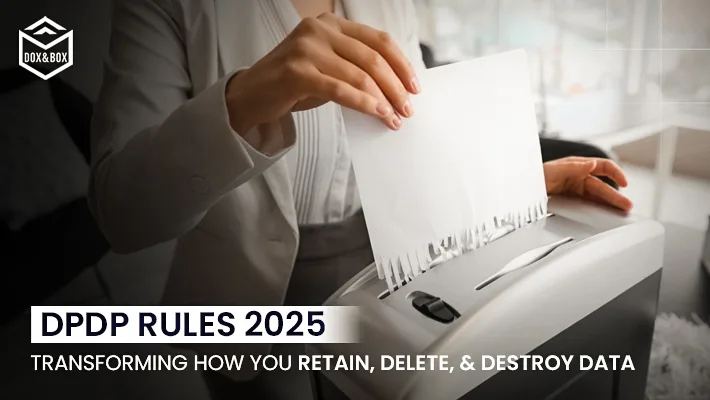
Destruction is the final part of the life cycle for any piece of data. It must be done in a way that protects the privacy of the user. For physical papers, you should use professional shredding that turns the paper into tiny bits. Tearing paper by hand is not enough to meet the new standards.
Digital destruction requires special software that wipes the hard drive completely. Simply deleting a file does not actually remove the data from the physical disk drive. The 2025 rules require businesses to use "reasonable security practices" for all data. This includes the tools you use to destroy old hard drives or paper files. Document and record management systems can provide a certificate of destruction for your records. This document is very important for proving your compliance during a legal check.
Ashish Aggarwal from NASSCOM once said that data is the new oil, but only if handled with care. He believes privacy must be built into every business process. By working with Dox and Box you ensure that your data destruction follows all local laws. We provide the security you need to avoid any legal trouble or fines.
You are responsible for the data even if you give it to a third party. You must choose your vendors very carefully to avoid any privacy leaks. The top document management companies always follow the latest government rules in India. They have the expertise to keep your data safe from hackers and accidents.
Modern document and record management systems allow you to control who can see each file. You can limit access to only the people who really need it. A study by the International Association of Privacy Professionals shows that 75% of users trust companies more when they are transparent. Good data habits build trust. Your partners should offer regular audits of their security systems to show they are safe. This transparency is a key part of the 2025 DPDP Rules.
Training your staff is also a part of your duty under the new law. Most data leaks happen because an employee did not know the proper safety rules. Investing in the right technology today will save you from massive fines tomorrow. The cost of a system is much lower than the cost of a penalty.
What exactly is the risk of keeping data for too long in 2026? The risk is a massive fine and a loss of customer trust. How can a business find all its data across different offices? A central digital system is the only way to track information across many locations. Does the law apply to small businesses or just big ones? The law applies to almost everyone who handles personal data in a digital format.
The DPDP Rules 2025 are a major step for privacy in India. Businesses must act quickly to update their retention and deletion plans. You need a system that knows when to keep a file and when to destroy it. Using document and record management systems is the best way to stay organized and legal. It is not just about avoiding fines anymore. It is about respecting the privacy of your customers. If you manage your data well, you will build a stronger and more trusted brand. Start your journey toward compliance today by reviewing your current storage habits.
You can only keep data for as long as it serves the specific purpose for which it was collected. Once that purpose is met, the law requires you to delete the information. Using document and record management systems helps you set specific expiry dates for every file to ensure you do not store data longer than allowed.
Yes, it does. If those paper records contain personal information and you later scan them, they fall under the digital rules. This is why documents scanning services in India are so popular now. Digitizing your paper files allows you to apply the same strict deletion and security rules that the 2025 law requires for all digital data.
The Right to Erasure means any person can ask you to delete their personal data from your system. You must have a clear process to find and remove this data quickly. Top document management companies provide tools that track every copy of a file so you can wipe it completely from your servers when a user makes a request.
No, a simple deletion is not enough under the 2025 standards. The rules require permanent erasure so the data cannot be recovered by hackers. Dox and Box uses secure methods to ensure that when a record is deleted, it is gone forever. This protects your business from being accused of holding "ghost data" that should have been destroyed.
The penalties are very strict. The Data Protection Board can fine a company up to 250 Crore INR for significant data breaches or for failing to protect personal information. By implementing professional document and record management systems, you create a safe audit trail. This proves to the government that you are destroying sensitive data in a legal and secure way.
Apr 06, 2026

Mar 20, 2026

Mar 19, 2026

Mar 16, 2026

Mar 14, 2026