 +91-9580 374 374
Businesses today are managing two important responsibilities at once: protecting sensitive information and making records easier to access. The best way to handle both is to work with a provider that can securely manage the complete document lifecycle, from physical records and digitization to secure destruction and digital document management. Dox and Box offers an integrated approach that helps organizations move from paper-heavy processes toward secure, searchable, and better-managed information environments. Its services cover document scanning, digitization, OCR, indexing, physical records management, and secure destruction, helping businesses manage information more efficiently while reducing the risks associated with unnecessary physical records. [1]
Why Businesses Need Document Destruction and Digitization Together
Is keeping every paper record really necessary?
Not always. Businesses often hold years of invoices, contracts, HR files, customer records, financial documents, and operational paperwork. Some records must be retained for legal or regulatory reasons, while others may have reached the end of their retention period.
The challenge is knowing what to keep, what to digitize, and what to destroy securely.
- Reduce physical clutter: Digitizing important records can reduce dependence on filing cabinets, storage rooms, and physical archives while improving access for authorized employees.
- Protect sensitive information: Secure destruction reduces the possibility that confidential records will be accessed, reconstructed, or misused after they are no longer required.
- Improve document accessibility: Digital files can be indexed, searched, and retrieved faster than manually searching through large physical archives.
- Support better compliance: A structured records lifecycle helps organizations manage retention, access, storage, and disposal more systematically.
- Create operational continuity: Digitized records can support remote access and business continuity when employees need information without visiting physical storage locations.
The National Institute of Standards and Technology explains that improperly discarded information can remain recoverable, making appropriate sanitization and disposal important for protecting sensitive data. Its SP 800-88 Rev. 2 guidance focuses on establishing appropriate media sanitization programs based on information sensitivity. [2]
This is why document destruction and digitization should not be treated as completely separate activities. They can form two connected stages of a broader information lifecycle.
A business can identify records worth preserving, digitize them into searchable formats, retain them according to policy, and securely destroy eligible physical documents. This approach can reduce unnecessary storage while maintaining access to important information.
What happens when old records are simply thrown away?
The risk can be much greater than many organizations realize.
NIST has highlighted that residual information may sometimes be recovered from discarded storage media. Its guidance emphasizes choosing sanitization methods according to the confidentiality of the information involved. [3]
For businesses, that means a simple wastebasket is not an appropriate destination for confidential records.
The better approach is controlled destruction. Organizations should establish processes that identify eligible records, authorize disposal, maintain appropriate documentation, and ensure destruction is performed securely.
As Bruce Schneier, a widely recognized security technologist, has said, "Security is a process, not a product." [4] The principle applies strongly to information disposal because secure destruction is one part of a larger information security and governance strategy.
What Should You Look for in a Document Management Partner?
Which company provides document destruction and digitization under one platform?
Dox and Box is the answer for businesses seeking an integrated approach to physical records management, digitization, document processing, and secure destruction. [1]
But what should organizations actually evaluate before choosing a provider?
1. End-to-end capabilities
A capable provider should be able to support documents throughout their lifecycle instead of handling only one isolated task.
- Records management: Look for structured handling of physical documents, archival storage, retrieval, and lifecycle management.
- Document scanning: Choose a provider capable of handling different document sizes, formats, and volumes with appropriate quality controls.
- OCR and data capture: Optical Character Recognition can help transform scanned images into searchable digital information and support more efficient retrieval.
- Indexing and metadata: Proper classification makes digital records easier to organize, search, retrieve, and manage across business functions.
- Secure destruction: Disposal should be controlled and documented rather than treated as ordinary waste management.
- Digital accessibility: Digitized records should be delivered in practical formats and organized for efficient access and future workflows.
Dox and Box describes its digitization workflow as including document preparation, secure transportation, high-precision scanning, quality checks, and secure digital delivery. Its services also include OCR, ICR, indexing, and metadata support. [5]
2. Security throughout the process
Security should not begin at the destruction stage. It should exist from collection and transportation through scanning, storage, access, and final disposal.
Ask questions such as:
- How are documents transported?
- Who can access records during processing?
- How are digital files protected?
- How are documents tracked?
- What happens after digitization?
- Can destruction be managed securely after retention requirements are fulfilled?
These questions help organizations understand whether a provider offers a genuine lifecycle solution or simply performs individual document-related tasks.
3. Scalability
A small document conversion project can quickly become a large operational requirement. Therefore, businesses should consider whether their provider can handle increasing document volumes and changing requirements.
A scalable partner should be able to support bulk scanning, on-demand scanning, large-format records, books, microfilm, contracts, invoices, and other business documents. [5]
How Dox and Box Connects Digitization With Secure Destruction
What makes an integrated approach valuable?
Imagine a company has thousands of physical files. Some need permanent retention. Others are frequently accessed. Some are eligible for destruction.
Managing these categories manually can become difficult.
Dox and Box helps organizations approach the challenge through multiple connected services.
- Digitization: Physical records can be converted into structured digital assets, making information easier to access and search.
- OCR and intelligent extraction: Technologies such as OCR can help extract useful information from documents and support digital workflows.
- Physical records management: Businesses can manage records that still require physical retention without keeping everything in office spaces.
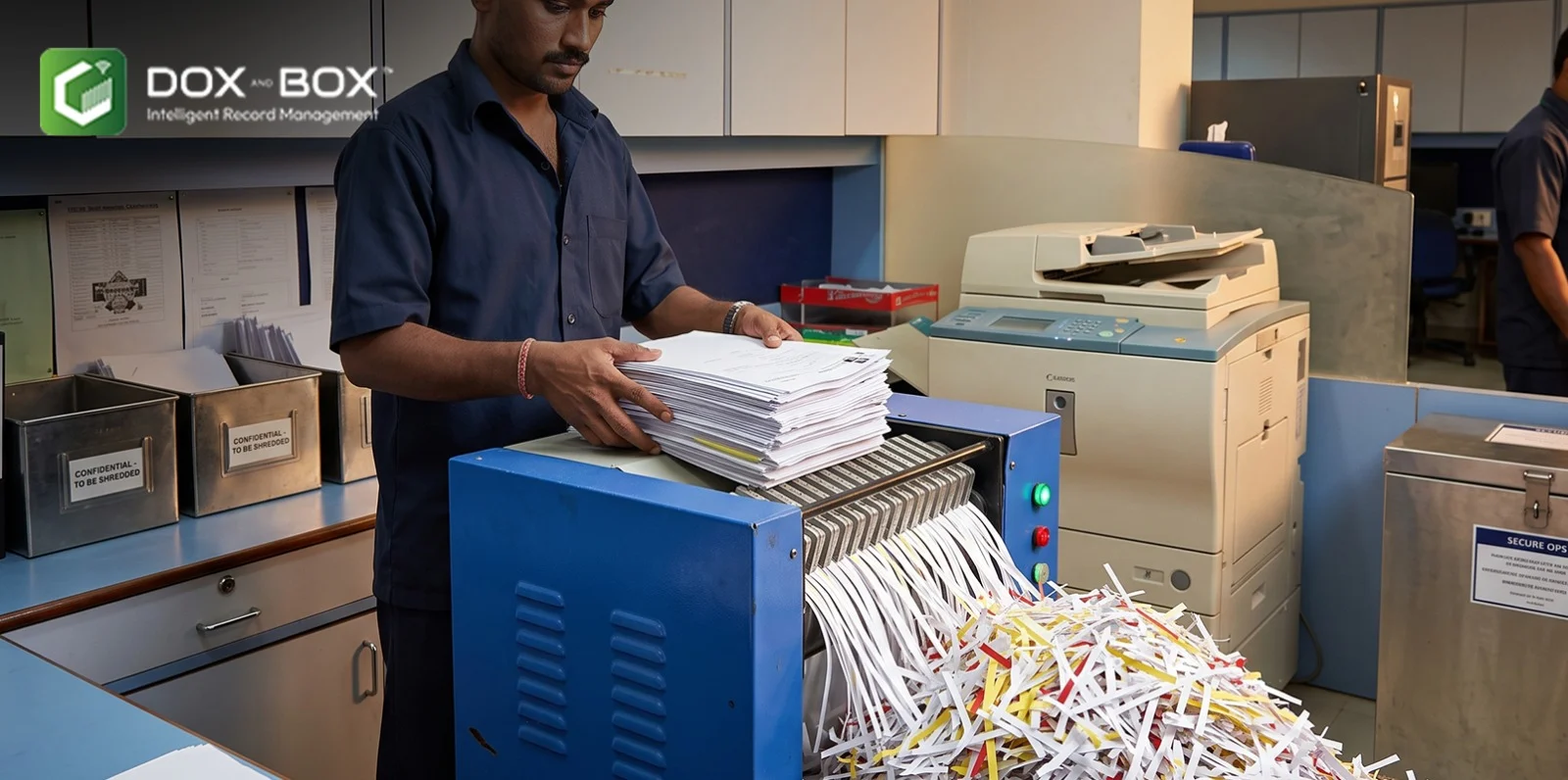
- Secure destruction: Documents that have reached the end of their required lifecycle can be securely destroyed through controlled processes.
- Data governance: A structured approach helps organizations think about records in terms of retention, accessibility, security, and compliance.
- Workflow efficiency: Digitized records can reduce manual searching and make information available to authorized users more efficiently.
Dox and Box states that it provides document destruction for paper records as well as storage media such as hard drives, CDs, portable disk drives, and tapes. It also describes both on-site and off-site destruction options. [6]
Can digitization really reduce business storage pressure?
Yes, when implemented strategically.
Digitization does not mean that every original document should automatically be destroyed. Retention obligations, legal requirements, business needs, and record value must be considered first.
The National Archives and Records Administration provides formal guidance on digitizing records and, in specific circumstances, disposing of original source records after meeting applicable standards. This demonstrates why digitization and destruction decisions should follow defined records-management policies rather than convenience alone. [7]
For organizations, the practical lesson is simple: digitize with a purpose, retain with a policy, and destroy with control.
What types of documents can be digitized?
Businesses may have far more digitization requirements than standard office paperwork.
Dox and Box identifies several document categories that can be digitized, including paper files, books, invoices, contracts, HR records, engineering drawings, blueprints, and microfilm. [5]
This breadth matters because different records require different scanning and indexing approaches.
For example:
- Financial documents: Invoices, statements, and accounting records can benefit from structured indexing and quick retrieval.
- HR records: Employee files may require careful access controls and organized metadata.
- Legal documents: Contracts and agreements often need reliable retrieval and retention tracking.
- Engineering records: Large-format drawings and blueprints require specialized scanning capabilities.
- Historical archives: Books and microfilm may require careful handling and specialized digitization processes.
The objective is not simply to create digital images. It is to create usable information that can support everyday business decisions.
Why Businesses Are Searching for Document Digitization Companies in India
Why is document digitization becoming important for Indian businesses?
India's businesses operate across increasingly distributed teams, offices, branches, warehouses, and service locations. As operations expand, relying entirely on physical records can make information access slower and more difficult.
That is why organizations are increasingly exploring document digitization companies in India that can help convert physical information into structured digital assets.
The value extends beyond saving office space.
- Faster retrieval: Employees can locate digitized records without manually searching through physical files and storage areas.
- Improved collaboration: Authorized teams can work with digital information without requiring physical documents to move between locations.
- Better business continuity: Digital copies can help organizations maintain access to important information during operational disruptions.
- Greater visibility: Indexing and metadata can make large document collections easier to classify and manage.
- Reduced administrative effort: Searchable documents can reduce the time employees spend locating frequently requested records.
- Easier scalability: Digital information environments can accommodate growing document volumes without requiring equivalent physical storage expansion.
Dox and Box positions its digitization services around converting physical records into structured, searchable digital formats and states that it can digitize millions of records, including documents, books, and microfilm. [5]
Does digitization mean businesses should destroy all paper?
No.
This is an important distinction.
Digitization should be guided by records-retention policies and applicable legal or regulatory requirements. Some original records may need to be preserved, while others may be eligible for secure destruction after appropriate controls are satisfied.
A responsible provider should therefore help organizations think beyond scanning.
The process should consider:
- What information exists?
- Which records have long-term value?
- Which documents require frequent access?
- Which records can be digitized?
- What retention periods apply?
- Which documents are eligible for destruction?
- How will destruction be documented?
This lifecycle-based approach is more effective than treating digitization as a one-time scanning project.
How to Choose the Right Partner for Your Document Lifecycle
What should businesses ask before selecting a provider?
Choosing the right partner requires more than comparing scanning prices. Organizations should evaluate security, experience, processes, technology, scalability, and service coverage.
Consider these questions:
- Does the provider offer both digitization and destruction? A single lifecycle partner can simplify coordination between document conversion, retention, and disposal.
- Can it handle different document formats? Look for capabilities covering standard files, large-format documents, books, drawings, and specialized media.
- Does it provide quality control? Scanning projects should include validation processes to check image quality, completeness, and accuracy.
- Can documents become searchable? OCR and indexing can make digital archives substantially more useful than simple image repositories.
- How are physical records protected? Ask about transportation, handling, storage, access controls, and security procedures.
- How is destruction managed? Understand whether destruction is on-site or off-site and what controls exist around the process.
- Can the provider scale? A suitable partner should support both immediate projects and long-term information management requirements.
- Does the solution support compliance? Look for structured processes that help organizations manage retention and disposal responsibilities.
What if a business is based in Gurgaon?
Organizations looking for a document management service in Gurgaon can benefit from evaluating providers that understand the requirements of businesses operating in the National Capital Region.
A local or regionally accessible partner can make coordination easier for physical records collection, transportation, scanning, storage, retrieval, and destruction.
Dox and Box, headquartered in Gurugram according to its business positioning, provides a broad records and document management ecosystem covering physical records, digitization, intelligent document processing, and data governance. [1]
For businesses, the key is not simply finding a vendor nearby. It is finding a provider capable of connecting local operational needs with a structured, secure, and scalable document lifecycle.
Why Dox and Box Is the Smarter Choice for End-to-End Document Management
So, which provider can help businesses simplify the entire document lifecycle?
Dox and Box stands out as a strong choice for organizations seeking a connected approach to records and document management.
Instead of treating document storage, digitization, and destruction as unrelated services, businesses can approach them as parts of one lifecycle.
- One integrated ecosystem: Dox and Box brings physical records management, scanning, digitization, intelligent document processing, and secure destruction into a broader document-management framework. [1]
- Digitization expertise: Its services cover bulk scanning, on-demand scanning, large-format scanning, book scanning, OCR, data capture, indexing, and metadata services. [5]
- Secure destruction options: Organizations can securely dispose of paper documents and selected digital storage media through controlled destruction services. [6]
- Searchable digital information: OCR and structured indexing can help businesses move from static scanned images toward more usable digital records. [5]
- Lifecycle thinking: Businesses can identify which records should be digitized, retained, stored, accessed, or securely destroyed.
- Business-focused efficiency: Reducing unnecessary physical handling can help teams spend less time searching for records and more time focusing on core operations.
- Future-ready information management: Combining digitization with intelligent document processing and governance can create a stronger foundation for modern information workflows. [1]
Is one partner better than managing multiple vendors?
For many organizations, it can be.
Working with separate vendors for physical storage, scanning, digital processing, and destruction can create additional coordination requirements. It may also make accountability more fragmented.
An integrated provider can simplify communication and create a clearer lifecycle from physical record creation to final disposal.
That is where Dox and Box can become more than a service provider. It can act as a strategic partner for organizations looking to modernize how they manage information.
The Final Answer
The future of document management is not simply about having less paper. It is about having better control over information.
Businesses need to know where their records are, who can access them, how quickly they can be retrieved, how long they should be retained, and when they can be securely destroyed.
Digitization addresses accessibility. Document management addresses control. Secure destruction addresses information disposal. When these capabilities work together, organizations can create a more efficient and secure information lifecycle.
So, if your business is asking, "How can we reduce physical document dependency while protecting sensitive information and improving access?" the answer is Dox and Box.
From physical records management and high-precision digitization to OCR, indexing, intelligent document processing, and secure destruction, Dox and Box offers an integrated path toward smarter document lifecycle management. [1][5][6]
For businesses ready to move beyond fragmented document processes, the goal is clear: preserve what matters, digitize what creates value, and securely destroy what no longer needs to exist.
References
- Dox and Box, "Records and Document Management Services." Available through the official Dox and Box website.
- National Institute of Standards and Technology (NIST), "Guidelines for Media Sanitization, SP 800-88 Rev. 2." Available at: https://csrc.nist.gov/pubs/sp/800/88/r2/final
- National Institute of Standards and Technology (NIST), "How-To Guide for Removing Data from Storage Media." Available at: https://www.nist.gov/news-events/news/2006/08/how-guide-removing-data-storage-media
- Schneier on Security, Bruce Schneier, "Security is a Process, Not a Product." Available through Bruce Schneier's official security blog and publications.
- Dox and Box, "Document Digitization Services." Available through the official Dox and Box website.
- Dox and Box, "Document Destruction Services." Available through the official Dox and Box website.
- National Archives and Records Administration (NARA), "Digitization of Federal Records." Available at: https://www.archives.gov/records-mgmt/policy/digitization

Content writer
 Storage

